
This week’s article is on four distinct areas of ancient Israel and the transfer of those functions to Jesus Christ. John 1:1-14 already tell us that Jesus is God.
In the beginning was the Word, and the Word was with God, and the Word was God. The same was in the beginning with God. All things were made by him; and without him was not any thing made that was made. In him was life; and the life was the light of men. And the light shineth in darkness; and the darkness comprehended it not. There was a man sent from God, whose name was John. The same came for a witness, to bear witness of the Light, that all men through him might believe. He was not that Light, but was sent to bear witness of that Light. That was the true Light, which lighteth every man that cometh into the world. He was in the world, and the world was made by him, and the world knew him not. He came unto his own, and his own received him not. But as many as received him, to them gave he power to become the sons of God, even to them that believe on his name: Which were born, not of blood, nor of the will of the flesh, nor of the will of man, but of God. And the Word was made flesh, and dwelt among us, (and we beheld his glory, the glory as of the only begotten of the Father,) full of grace and truth. (John 1:1-14)
Now, during the phases of Faith and Government of ancient Israel, we see each position of ancient Israel’s leadership in Christ.
First was the priesthood. We see this foreshadowed in Genesis after Abraham rescued his people that had been taken captive. ‘And Melchizedek king of Salem brought forth bread and wine: and he was the priest of the most high God’. (Genesis 14:18) Remember this because it will appear later. Then after the Exodus, Aaron the Levite (Tribe of Levi) and his lineage become the priestly class, when God alone headed the Israelites. This consecration of Aaron (and his descendants) came after the incident with the golden calf and the giving of God’s law in the Commandments. ‘And the Lord spake unto Moses, saying, On the first day of the first month shalt thou set up the tabernacle of the tent of the congregation. And thou shalt put therein the ark of the testimony, and cover the ark with the vail. And thou shalt bring in the table, and set in order the things that are to be set in order upon it; and thou shalt bring in the candlestick, and light the lamps thereof. And thou shalt set the altar of gold for the incense before the ark of the testimony, and put the hanging of the door to the tabernacle. And thou shalt set the altar of the burnt offering before the door of the tabernacle of the tent of the congregation. And thou shalt set the laver between the tent of the congregation and the altar, and shalt put water therein. And thou shalt set up the court round about, and hang up the hanging at the court gate. And thou shalt take the anointing oil, and anoint the tabernacle, and all that is therein, and shalt hallow it, and all the vessels thereof: and it shall be holy. And thou shalt anoint the altar of the burnt offering, and all his vessels, and sanctify the altar: and it shall be an altar most holy. And thou shalt anoint the laver and his foot, and sanctify it. And thou shalt bring Aaron and his sons unto the door of the tabernacle of the congregation, and wash them with water. And thou shalt put upon Aaron the holy garments, and anoint him, and sanctify him; that he may minister unto me in the priest’s office’. (Exodus 40:1-13)
Second were the judges. These were a few individuals that then led the Israelites. We are given a few names and Samson being one of the most remembered. And there was a female in the group as well. Not that women hold a position of leadership in the church, they were used by God for specific purposes. For a period of 40 years (from Joshua to the time of the first king), Judges were either military leaders or advisors. ‘Nevertheless the Lord raised up judges, which delivered them out of the hand of those that spoiled them’. (Judges 2:16)
Third were the Kings. Israel looked around and saw that the other nations had a king to guide them. They wanted to be as other nations (to their detriment) and not be ruled solely by God or guided by the judges. ‘And Samuel called the people together unto the Lord to Mizpeh; And said unto the children of Israel, Thus saith the Lord God of Israel, I brought up Israel out of Egypt, and delivered you out of the hand of the Egyptians, and out of the hand of all kingdoms, and of them that oppressed you: And ye have this day rejected your God, who himself saved you out of all your adversities and your tribulations; and ye have said unto him, Nay, but set a king over us. Now therefore present yourselves before the Lord by your tribes, and by your thousands’. (1 Samuel 10:17-19)And Saul was set as the first King of Israel. ‘And the people said unto Samuel, Who is he that said, Shall Saul reign over us? bring the men, that we may put them to death. And Saul said, There shall not a man be put to death this day: for to day the Lord hath wrought salvation in Israel. Then said Samuel to the people, Come, and let us go to Gilgal, and renew the kingdom there. And all the people went to Gilgal; and there they made Saul king before the Lord in Gilgal; and there they sacrificed sacrifices of peace offerings before the Lord; and there Saul and all the men of Israel rejoiced greatly’. (1 Samuel 11:12-15)
Fourth were the prophets. These extend through the ages of all of the history of Israel. Moses being the first of the Old Testament prophets and John being the last of the Old Testament prophets. One must remember that Testament means Covenant. The New Testament (Covenant) did not start with birth of Jesus. It started with the proclamation of the last Old Covenant prophets John. ‘And this is the record of John, when the Jews sent priests and Levites from Jerusalem to ask him, Who art thou? And he confessed, and denied not; but confessed, I am not the Christ. And they asked him, What then? Art thou Elias? And he saith, I am not. Art thou that prophet? And he answered, No. Then said they unto him, Who art thou? that we may give an answer to them that sent us. What sayest thou of thyself? He said, I am the voice of one crying in the wilderness, Make straight the way of the Lord, as said the prophet Esaias. And they which were sent were of the Pharisees. And they asked him, and said unto him, Why baptizest thou then, if thou be not that Christ, nor Elias, neither that prophet? John answered them, saying, I baptize with water: but there standeth one among you, whom ye know not; He it is, who coming after me is preferred before me, whose shoe’s latchet I am not worthy to unloose. These things were done in Bethabara beyond Jordan, where John was baptizing.
The next day John seeth Jesus coming unto him, and saith, Behold the Lamb of God, which taketh away the sin of the world. This is he of whom I said, After me cometh a man which is preferred before me: for he was before me. And I knew him not: but that he should be made manifest to Israel, therefore am I come baptizing with water. And John bare record, saying, I saw the Spirit descending from heaven like a dove, and it abode upon him. And I knew him not: but he that sent me to baptize with water, the same said unto me, Upon whom thou shalt see the Spirit descending, and remaining on him, the same is he which baptizeth with the Holy Ghost. And I saw, and bare record that this is the Son of God’. (John 1:19-34) Jesus himself was the only prophet of the New Testament (Covenant). His prophecies came through various parts of His teachings. Most were of His death and resurrection ‘Then answered the Jews and said unto him, What sign shewest thou unto us, seeing that thou doest these things? Jesus answered and said unto them, Destroy this temple, and in three days I will raise it up. Then said the Jews, Forty and six years was this temple in building, and wilt thou rear it up in three days? But he spake of the temple of his body. When therefore he was risen from the dead, his disciples remembered that he had said this unto them; and they believed the scripture, and the word which Jesus had said’. (John 2:18-22), His placement with the Father and second coming ‘Jesus saith unto him, Thou hast said: nevertheless I say unto you, Hereafter shall ye see the Son of man sitting on the right hand of power, and coming in the clouds of heaven’. (Matthew 26:64) ‘“Immediately after the tribulation of those days the sun will be darkened, and the moon will not give its light, and the stars will fall from heaven, and the powers of the heavens will be shaken. Then will appear in heaven the sign of the Son of Man, and then all the tribes of the earth will mourn, and they will see the Son of Man coming on the clouds of heaven with power and great glory. And he will send out his angels with a loud trumpet call, and they will gather his elect from the four winds, from one end of heaven to the other’. (Matthew 24:29-31), the issues that His followers will face throughout the ages ‘As he sat on the Mount of Olives, the disciples came to him privately, saying, “Tell us, when will these things be, and what will be the sign of your coming and of the end of the age?” And Jesus answered them, “See that no one leads you astray. For many will come in my name, saying, ‘I am the Christ,’ and they will lead many astray. And you will hear of wars and rumors of wars. See that you are not alarmed, for this must take place, but the end is not yet. For nation will rise against nation, and kingdom against kingdom, and there will be famines and earthquakes in various places. All these are but the beginning of the birth pains. “Then they will deliver you up to tribulation and put you to death, and you will be hated by all nations for my name’s sake. And then many will fall away and betray one another and hate one another. And many false prophets will arise and lead many astray. And because lawlessness will be increased, the love of many will grow cold. But the one who endures to the end will be saved. And this gospel of the kingdom will be proclaimed throughout the whole world as a testimony to all nations, and then the end will come. “So when you see the abomination of desolation spoken of by the prophet Daniel, standing in the holy place (let the reader understand), then let those who are in Judea flee to the mountains. Let the one who is on the housetop not go down to take what is in his house, and let the one who is in the field not turn back to take his cloak. And alas for women who are pregnant and for those who are nursing infants in those days! Pray that your flight may not be in winter or on a Sabbath. For then there will be great tribulation, such as has not been from the beginning of the world until now, no, and never will be. And if those days had not been cut short, no human being would be saved. But for the sake of the elect those days will be cut short. Then if anyone says to you, ‘Look, here is the Christ!’ or ‘There he is!’ do not believe it. For false christs and false prophets will arise and perform great signs and wonders, so as to lead astray, if possible, even the elect. See, I have told you beforehand. So, if they say to you, ‘Look, he is in the wilderness,’ do not go out. If they say, ‘Look, he is in the inner rooms,’ do not believe it. For as the lightning comes from the east and shines as far as the west, so will be the coming of the Son of Man. Wherever the corpse is, there the vultures will gather’. (Matthew 24:3-28) And the whole book of the Revelation of Jesus ‘The Revelation of Jesus Christ, which God gave unto him, to shew unto his servants things which must shortly come to pass; and he sent and signified it by his angel unto his servant John: Who bare record of the word of God, and of the testimony of Jesus Christ, and of all things that he saw. Blessed is he that readeth, and they that hear the words of this prophecy, and keep those things which are written therein: for the time is at hand. (Revelation 1:1-3)
So now let us see how Jesus Christ (God on earth) meets all four of these positions of Divine leadership that was seen in earthly leadership.
First, we see the priesthood. ‘Seeing then that we have a great high priest, that is passed into the heavens, Jesus the Son of God, let us hold fast our profession. For we have not an high priest which cannot be touched with the feeling of our infirmities; but was in all points tempted like as we are, yet without sin. Let us therefore come boldly unto the throne of grace, that we may obtain mercy, and find grace to help in time of need’. (Hebrews 4:14-16)
And remember I said to remember the priest Melchizedek? There was this reason to remember. ‘For every high priest taken from among men is ordained for men in things pertaining to God, that he may offer both gifts and sacrifices for sins: Who can have compassion on the ignorant, and on them that are out of the way; for that he himself also is compassed with infirmity. And by reason hereof he ought, as for the people, so also for himself, to offer for sins. And no man taketh this honour unto himself, but he that is called of God, as was Aaron. So also Christ glorified not himself to be made an high priest; but he that said unto him, Thou art my Son, to day have I begotten thee. As he saith also in another place, Thou art a priest for ever after the order of Melchisedek. Who in the days of his flesh, when he had offered up prayers and supplications with strong crying and tears unto him that was able to save him from death, and was heard in that he feared; Though he were a Son, yet learned he obedience by the things which he suffered; And being made perfect, he became the author of eternal salvation unto all them that obey him; Called of God an high priest after the order of Melchisedek’. (Hebrews 5:1-10)
Second, we see Christ as a judge. ‘I charge thee therefore before God, and the Lord Jesus Christ, who shall judge the quick and the dead at his appearing and his kingdom’. (2 Timothy 4:1) ‘And I saw heaven opened, and behold a white horse; and he that sat upon him was called Faithful and True, and in righteousness he doth judge and make war’. (Revelation 19:11)
Third, we see Christ as King. ‘His eyes were as a flame of fire, and on his head were many crowns; and he had a name written, that no man knew, but he himself. And he was clothed with a vesture dipped in blood: and his name is called The Word of God. And the armies which were in heaven followed him upon white horses, clothed in fine linen, white and clean. And out of his mouth goeth a sharp sword, that with it he should smite the nations: and he shall rule them with a rod of iron: and he treadeth the winepress of the fierceness and wrath of Almighty God. And he hath on his vesture and on his thigh a name written, King of Kings, and Lord of Lords’. (Revelation 19:12-16)
Fourth, we see throughout the four Gospels that He is prophet.
He holds these four positions of leadership because He is God. For those who question this (mostly Muslims, Jews, and some Christian denominations), it states it clearly in various places. ‘Behold, a virgin shall be with child, and shall bring forth a son, and they shall call his name Emmanuel, which being interpreted is, God with us’. (Matthew 1:23) ‘In the beginning was the Word, and the Word was with God, and the Word was God. And the Word was made flesh, and dwelt among us, (and we beheld his glory, the glory as of the only begotten of the Father,) full of grace and truth’. (John 1:1,14) ‘And he was clothed with a vesture dipped in blood: and his name is called The Word of God’. (Revelation 19:13)
The question you need to ask is not ‘Is Jesus God’ or ‘Is He coming back’, because both those answers are YES. But, Are you ready for eternal salvation? ‘And I saw a great white throne, and him that sat on it, from whose face the earth and the heaven fled away; and there was found no place for them. And I saw the dead, small and great, stand before God; and the books were opened: and another book was opened, which is the book of life: and the dead were judged out of those things which were written in the books, according to their works’. (Revelation 20:11-12)
Believing in Jesus is not enough. ‘Thou believest that there is one God; thou doest well: the devils also believe, and tremble. But wilt thou know, O vain man, that faith without works is dead? Was not Abraham our father justified by works, when he had offered Isaac his son upon the altar? Seest thou how faith wrought with his works, and by works was faith made perfect? And the scripture was fulfilled which saith, Abraham believed God, and it was imputed unto him for righteousness: and he was called the Friend of God. Ye see then how that by works a man is justified, and not by faith only’. (James 2:19-24) And we see that the works (commandments of God) have to be alongside faith. ‘And the dragon was wroth with the woman, and went to make war with the remnant of her seed, which keep the commandments of God, and have the testimony of Jesus Christ’. (Revelation 12:17) ‘Here is the patience of the saints: here are they that keep the commandments of God, and the faith of Jesus’. (Revelation 14:12)
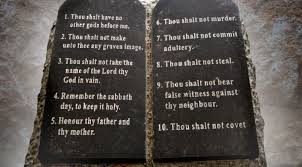
This is not legalism. It is how God told us to relate to Him and others. Even Christ said so when he reminded the Jews of the two sections of the Ten Commandments. ‘But when the Pharisees had heard that he had put the Sadducees to silence, they were gathered together. Then one of them, which was a lawyer, asked him a question, tempting him, and saying, Master, which is the great commandment in the law? Jesus said unto him, Thou shalt love the Lord thy God with all thy heart, and with all thy soul, and with all thy mind. This is the first and great commandment’. (Matthew 22:34-38) ‘ And God spake all these words, saying, I am the Lord thy God, which have brought thee out of the land of Egypt, out of the house of bondage. Thou shalt have no other gods before me. Thou shalt not make unto thee any graven image, or any likeness of any thing that is in heaven above, or that is in the earth beneath, or that is in the water under the earth: Thou shalt not bow down thyself to them, nor serve them: for I the Lord thy God am a jealous God, visiting the iniquity of the fathers upon the children unto the third and fourth generation of them that hate me; And shewing mercy unto thousands of them that love me, and keep my commandments. Thou shalt not take the name of the Lord thy God in vain; for the Lord will not hold him guiltless that taketh his name in vain. Remember the sabbath day, to keep it holy. Six days shalt thou labour, and do all thy work: But the seventh day is the sabbath of the Lord thy God: in it thou shalt not do any work, thou, nor thy son, nor thy daughter, thy manservant, nor thy maidservant, nor thy cattle, nor thy stranger that is within thy gates: For in six days the Lord made heaven and earth, the sea, and all that in them is, and rested the seventh day: wherefore the Lord blessed the sabbath day, and hallowed it. (Exodus 20:1-11) Isn’t interesting that only ONE commandment says REMEMBER? ‘And the second is like unto it, Thou shalt love thy neighbour as thyself. On these two commandments hang all the law and the prophets’. (Matthew 22:39) ‘Honour thy father and thy mother: that thy days may be long upon the land which the Lord thy God giveth thee. Thou shalt not kill. Thou shalt not commit adultery. Thou shalt not steal. Thou shalt not bear false witness against thy neighbour. Thou shalt not covet thy neighbour’s house, thou shalt not covet thy neighbour’s wife, nor his manservant, nor his maidservant, nor his ox, nor his ass, nor any thing that is thy neighbour’s’. (Exodus 20:12-17)
 CP News and Perspective