Christianity, doctrine, faith, Theology, Uncategorized

Biblical Baptism

Over the last couple of months, three of my children have been baptized with believer’s baptism. This type of baptism comes in the form of full immersion, an the words of Jesus in Matthew 28:18-19. ‘And Jesus came and spake unto them, saying, All power is given unto me in heaven and in earth.Go ye therefore, and teach all nations, baptizing them in the name of the Father, and of the Son, and of the Holy Ghost:’.

So today, I would like to speak about baptism in the New Testament and beyond. The first New Testament baptism is John’s baptism prior to the baptism of Jesus. Now in the fifteenth year of the reign of Tiberius Caesar, Pontius Pilate being governor of Judaea, and Herod being tetrarch of Galilee, and his brother Philip tetrarch of Ituraea and of the region of Trachonitis, and Lysanias the tetrarch of Abilene,   Annas and Caiaphas being the high priests, the word of God came unto John the son of Zacharias in the wilderness.   And he came into all the country about Jordan, preaching the baptism of repentance for the remission of sins;’ (Luke 3:1-3)

According to the Jewish Mikveh ritual, which is used for various reasons, total immersion is used for purification. This is believed to be the reason that John was baptizing as part of his ministry. To purify the person in the eyes of God. Purification was a part of everyday life. Women needed purification after their menstrual cycle. The diseased needed purification after healing. And with the holiest feast being for the Day of Atonement, purification was needed to present sacrifice, for the priests to enter into their duties, and the High Priest to enter the Holy of Holies. So as part of preparing the way of the Messiah, it would be natural for John to incorporate this ritual into his ministry.

Christ required full immersion to fulfill the symbolic purification. Then cometh Jesus from Galilee to Jordan unto John, to be baptized of him.   But John forbad him, saying, I have need to be baptized of thee, and comest thou to me?   And Jesus answering said unto him,  Suffer it to be so now: for thus it becometh us to fulfil all righteousness.  Then he suffered him.   And Jesus, when he was baptized, went up straightway out of the water: and, lo, the heavens were opened unto him, and he saw the Spirit of God descending like a dove, and lighting upon him:   And lo a voice from heaven, saying, This is my beloved Son, in whom I am well pleased.’ (Matthew 3:13-17)

Peter changed the wording. He removed the ‘Father,Son, Holy Spirit’ replacing it with the Name and title of Jesus. Then Peter said unto them, Repent, and be baptized every one of you in the name of Jesus Christ for the remission of sins, and ye shall receive the gift of the Holy Ghost.’ (Acts 2:38)

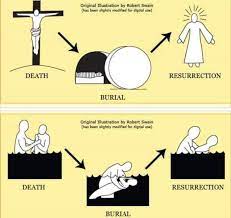
Most churches use the version taught by Jesus. Some New Testament churches use Peter’s version. So one needs to contemplate, when it comes to wording, to listen to the Apostle or to the Lord when speaking during baptism. This baptismal form shows the death, burial, and resurrection of Christ.

Over time, other forms of baptism came to be used. Sprinkling and pouring are the two that are most notable. Pouring comes not from scripture but from the Didache (which has been posted on this site). In the Didache, the writer’s (reportedly Apostles and disciples of the 1st and 2nd centuries) gave baptismal instruction. From Didache 7:1 CONCERNING BAPTISM” ‘ Concerning baptism, baptize in this way. Having instructed him in all of these teachings, baptize the  catechumen in the name of the Father, and of the Son, and of the Holy Spirit, in running water.  But  if you do not have running water, then baptize in other water. And if you cannot in cold water, use warm.  But if you have neither, then pour water on the head three times, in the name of the Father, and of the Son,  and of the Holy Spirit. And before the baptism, let both the baptizer and the catechumen fast, and also any  others who are able. And be sure that the catechumen fasts a day or two before.

Those who use sprinkling (such as the Catholic Church and the Presbyterian church) use two sources for their reasoning. The difference between the classical Greek word baptizmo (immerse) and the 1st Century Greek word koine (washing or cleansing). They site Ezekiel as a source for sprinkling in baptism. Then will I sprinkle clean water upon you, and ye shall be clean: from all your filthiness, and from all your idols, will I cleanse you.   A new heart also will I give you, and a new spirit will I put within you: and I will take away the stony heart out of your flesh, and I will give you an heart of flesh.   And I will put my spirit within you, and cause you to walk in my statutes, and ye shall keep my judgments, and do them.’ (Ezekiel 36:25-27)

One more matter in the concept of baptism. That is infant baptism. Most Christian churches do have an infant ceremony, christening. This is to give the child a name, give the child to God, and to dedicate the child’s rearing in the faith.

Some churches, like the Catholic Church and some Protestant denominations, give full baptism to infants. Having been Catholic for a couple decades before leaving and becoming Protestant, some of my children were given infant baptism. And those churches use the story of Cornelius and the jailer to justify that practice. ‘While Peter yet spake these words, the Holy Ghost fell on all them which heard the word.   And they of the circumcision which believed were astonished, as many as came with Peter, because that on the Gentiles also was poured out the gift of the Holy Ghost.   For they heard them speak with tongues, and magnify God. Then answered Peter,   Can any man forbid water, that these should not be baptized, which have received the Holy Ghost as well as we?   And he commanded them to be baptized in the name of the Lord. Then prayed they him to tarry certain days.’ (Acts 10:44-48). And he took them the same hour of the night, and washed their stripes; and was baptized, he and all his, straightway.’ (Acts 16:27)

While neither of these verses say directly infants were  baptized, those that do infant baptisms believe it is implied. Most Christian denominations and Independents believe that believer’s baptism is the scriptural standard. Many verses say so specifically. Acts 2:38, Mark 16:16, Matthew 28:19, Acts 2:41, etc, all speak of believing in Jesus’s redemptive power and then baptism.

While baptism is an outward sign, it is not part of the redemption of Christ. Only the acceptance of His gift of Salvation saves us. 
Standard
Christianity, faith

What is the biblical celebration of the Resurrection of Christ?

While sitting in service, on this day that the majority of Christendom celebrates the Resurrection of Jesus the Christ, it made me wonder and contemplate the celebration. As I approached the church, outside along the sidewalk, there were brightly colored easter eggs. As I walked into the sanctuary, there were flowers on the mourner’s bench, a board cutout of the tomb, and I wondered what would transpire.

The church I attended was a United Methodist Church. I have been to it many times and I enjoy hearing the pastor. But today, a retired preacher was giving the message. It started out with memories of Easter Sunday’s gone by. Eggs, baskets, bunnies. And for the next 10 minutes or so, we were taken down that bunny trail. Then the message turned to Jesus and the story from John 20:1-18. This is the telling of the Mary’s visiting the tomb and finding it empty. Then Mary Magdalene speaking with Jesus at the tomb.

This part of the message was expected. However, starting the story of rabbits and eggs didn’t feel right. Not that these images have been used for centuries, if not longer. But because we understand that these images have a meaning older than our faith. The various uses of signs of new birth and fertility have been used in many pre-Christian cultures and belief systems. Even the term Easter has its roots in paganism. It was originally celebrated through the pagan cultures that celebrated the spring equinox. The equinoxes and solstices were the pagan ways of determining the seasons and held festivals in response to them. I’m not going to debate that the Catholic Church incorporated many pagan beliefs and festivals into the ‘Christian faith’. That part doesn’t need debating, its true.

But what I do choose to present, is the biblical celebration of the death, burial, and resurrection of Jesus Christ. Because when you look at Holy Scripture, you don’t see the Christian festivals we now support in the church. I have already written an article on the aspects associated with Halloween. So now, let’s see in Scripture, if an celebration from cross to empty grave exists.

Romans 6:3-5 states. “Know ye not, that so many of us as were baptized into Jesus Christ were baptized into his death? Therefore we are buried with him by baptism into death: that like as Christ was raised up from the dead by the glory of the Father, even so we also should walk in newness of life. For if we have been planted together in the likeness of his death, we shall be also in the likeness of his resurrection”

So, there is the answer to how the early Christian Church celebrated the death, burial, and resurrection of Jesus. BAPTISM. Some see it as a public announcement of our faith. Many see it as a sign of new birth. It is both. But more importantly, it is the celebration of the resurrection.

Let us look at the three parts of baptism. Going into the water shows our reenactment of the death of Christ on the cross. Then when submerged and underwater, we have been entombed. Coming back up out of the water is our personal symbol of Christ’s resurrection. Jesus told told Nicodemus that to be made a part of the Kingdom of God, one must be born again. (John 3:1-21). So the rebirth (like our original birth) happens as we come out of a fluid (amniotic/baptismal). The actions themselves are the biblical celebration of the crucifixion, death, burial, and resurrection of our Lord Jesus the Christ.

While man has sought to through the ages to use non-faith ideologies and actions to celebrate various aspects of the Gospel accounts, Easter is, and always will be, pagan in origin and imagery. Just because on slaps the identity of Christian and a picture of Jesus on something, does not make it biblical or Christian.

This is the last easter celebration I will partake in. Having explained the paganism to my children, it will be up to them and their mother/stepfather to either reinforce the true biblical steps we are to take in Christ. When they are with me, from now until time ends, this is the way it has to be. For those believers in Christ as their Savior, I ask only this. That you study Scripture and history together to see where many ‘Christian’ traditions came from.

Have a wonderful and blessed day.

Standard
Christianity, faith, Uncategorized

Didache repost part 2

This is part two of my Didache series. The Didache is the teachings of the original Apostles of Christ. It is also the second oldest Christian writings, only second behind Holy Scripture. Original printing issues are not replaced. All Scriptural references have been moved to bottom of article.

DIDACHE 8 — II — INSTRUCTION FOR CATECHUMENS

CONCERNING FOOD N ow concerning eating, observe the traditions as best you can. But do not eat meat sacrificed to idols,  for it is the worship of dead gods.

CONCERNING BAPTISM concerning baptism, baptize in this way. Having instructed him in all of these teachings, baptize the  catechumen in the name of the Father, and of the Son, and of the Holy Spirit, in running water.v  But  if you do not have running water, then baptize in other water. And if you cannot in cold water, use warm.  But if you have neither, then pour water on the head three times, in the name of the Father, and of the Son,  and of the Holy Spirit. And before the baptism, let both the baptizer and the catechumen fast, and also any  others who are able. And be sure that the catechumen fasts a day or two before.

CONCERNING FASTING d o NoT let not your fasts fall on the same days as the hypocrites,w for they fast on Mondays and Thursdays. Keep your fast on Wednesdays and Fridays.

CONCERNING PRAYER d o NoT pray as the hypocrites either,x  but pray as the Lord commanded in His Gospel:  Our Father, who art in heaven, hallowed be thy name; thy kingdom come; thy will be done, on  earth as it is in heaven; give us this day our daily bread; and forgive us our trespasses, as we forgive those  who trespass against us; and lead us not into temptation, but deliver us from the evil one; for thine is the  power and the glory unto ages of ages.y Pray this way three times each day.

CONCERNING THE EUCHARIST N ow concerning the eucharistic thanksgiving,z  give thanks in this way. First, as concerning the cup: We give you thanks, our Father, for the holy vine of your son David,a  which you made known  to us through your Son Jesus.b  Yours is the glory unto ages of ages. Then as regards the broken bread: We give you thanks, our Father, for the life and knowledge  which you made known to us through your  Son Jesus. Yours is the glory unto ages of ages. As this broken bread was scattered upon the mountains and being gathered together became one,  u . so may your Church be gathered together from the ends of the earth into your kingdom. For yours is the  glory and the power through Jesus Christ unto ages of ages. Do not let anyone eat or drink of this Eucharist who has not been baptized into the name of the Lord,  for concerning this the Lord has said, “Do not give the holy things to the dogs.”d And after you have been flled, give thanks as follows:  We give you thanks, holy Father, for your holy name, which you have made to dwell in our hearts,e and for the knowledge and faith and immortality, which you have made known unto us through your Son  Jesus. Yours is the glory unto ages of ages. You, Almighty Master, created all thingsf  for your name’s sake, and gave food and drink to men for  their enjoyment, that they might give you thanks. And you have given us spiritual food and drink and  eternal life through your Son.g Most of all, we give you thanks that you are powerful. Yours is the glory unto ages of ages. Remember, Lord, your Church,h  and deliver it from all evili  and to perfect it in Thy love. Gather it— the sanctifed one—together from the four windsj  into your kingdom which you have prepared for it. For  yours is the power and the glory unto ages of ages. May grace come and may this world pass away.k  Hosanna to the God of David.l  If any man is holy, let  him come; if any man is not, let him repent. Mar‘anatha. m Amen. But permit the prophets to ofer thanksgiving as much as they desire.

CONCERNING THE OINTMENT aNd concerning the ointment, give thanks as follows: We give you thanks, our Father, for the fragrant ointment which you have made known to us  through your Son Jesus. Yours is the glory unto ages of ages. Amen.

THE APPROVED TEACHER whoever comes and teaches you all these things that have been taught before, receive him. But if  the teacher himself turns aside and teaches a diferent doctrine that subverts what has been taught  before, do not listen to him.n  If his teaching fosters righteousness and the knowledge of the Lord, receive  him as the Lord.o .

Scriptural references:

U Acts 15:29. v Mat. 28:19. w Mat. 6:16. x Mat. 6:5f. y Mat. 6:9f. z 1 Cor. 11:23-25. a John 15:1. b Acts 3:13, 26. c John 3:15, 5:26, 6:68f

d Mat. 7:6. e John 1:14, 6:56-57. f Rev. 4:11. g John 6:27. h Mat. 16:18. i John 17:15. j Mat. 24:31. k Rev. 22:20. l Mat. 21:9, 15. m Hebrew: “Our Lord has come.” 1 Cor. 16:22. n Gal. 1:6-9. o Mat. 10:40; John 13:20

Standard